
What does plaque psoriasis look and feel like?
Plaque psoriasis often forms raised, fairly well-defined areas with dry scale. They may itch, hurt, or crack and commonly occur on the elbows, knees, scalp, and lower back, although other areas can be affected.
The colour is not the same for everyone. Inflammation can look different across skin tones, and darker or lighter marks may remain after a plaque settles. Redness that is hard to see does not mean the condition has little impact.
What is guttate psoriasis?
Guttate psoriasis often causes many small lesions across the trunk, arms, or legs. It may follow certain infections, particularly streptococcal throat infection. A clinician assesses the history and distinguishes it from other widespread rashes.
How is inverse psoriasis different?
Inverse psoriasis affects skin folds such as the armpits, groin, beneath the breasts, or between the buttocks. It may look smoother and have less scale than psoriasis on dry skin, so it can resemble fungal infection, irritation, or seborrhoeic dermatitis.
Skin in folds and the genital area is sensitive. An unsuitable topical medicine can irritate it or cause adverse effects, so diagnosis and instructions should come from a clinician.
Why do pustular and erythrodermic psoriasis matter?
Pustular psoriasis causes pustules that are not necessarily due to infection and may be limited to the palms and soles or become widespread. Erythrodermic psoriasis causes inflammation over a large area. Either can become serious when widespread or accompanied by systemic symptoms.
Seek urgent care if the rash spreads quickly, the skin is very painful, many pustules appear, or there is fever, chills, a fast heartbeat, or feeling very unwell. Do not wait for a routine appointment or try to treat these symptoms alone.
How can psoriasis affect the scalp, nails, and high-impact areas?
Scalp psoriasis can produce scale and extend beyond the hairline, but it may be difficult to distinguish from dandruff, seborrhoeic dermatitis, or fungal infection by appearance alone. Nails may pit, thicken, change colour, lift, or develop material beneath them, but fungal nail disease can look similar.
The face, scalp, nails, palms, soles, folds, and genitals may involve little surface area yet greatly affect hand use, walking, sleep, confidence, or relationships. Severity should not be judged only by the size of the rash.
Educational images by body area
Visible features and affected locations can vary. These images are grouped by body area only to explain what is visible. They are not grouped by type or severity and should not be compared for self-diagnosis.
Scalp and hairline
These viewpoints show only the visible hairline and scalp areas. A viewing angle is not evidence of type or severity.
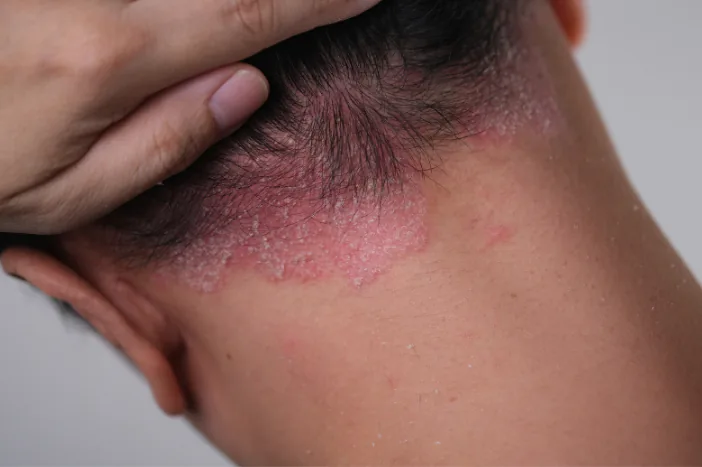
Image example of the rear hairline and nape. Visible features in an image alone cannot confirm a diagnosis. 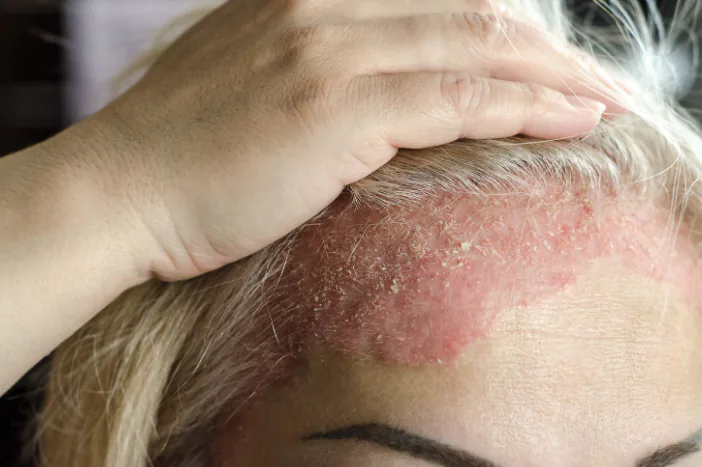
Image example of the front hairline. A single close image is not a diagnostic test. 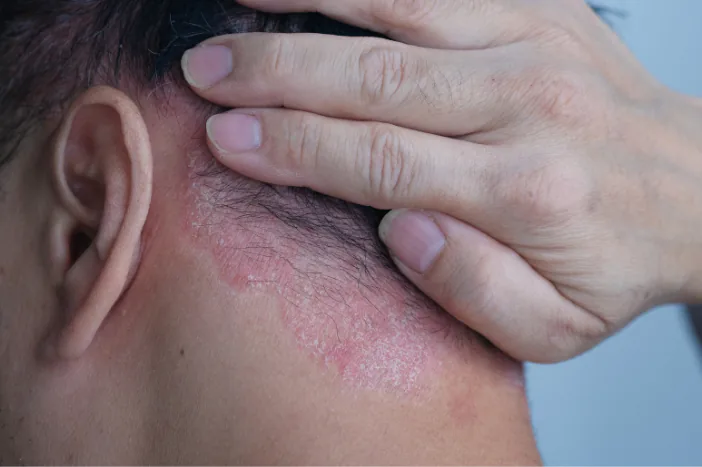
Image example of the side-to-rear hairline. The viewing angle cannot determine type or severity. 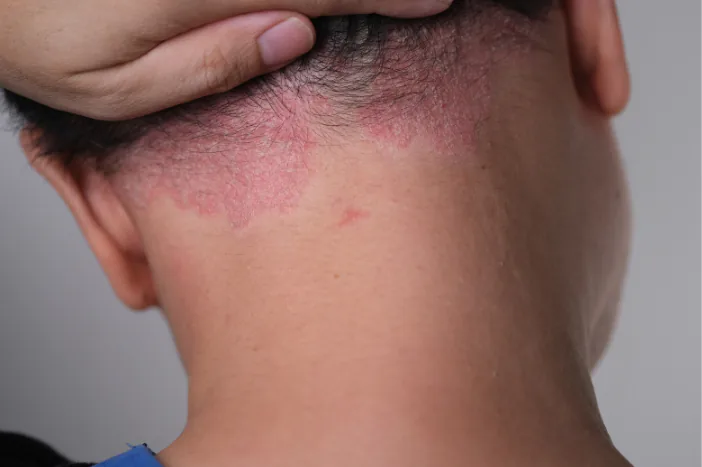
Image example of the rear hairline. It shows only what is visible in the frame and does not confirm a diagnosis.
Arms, legs, and trunk
These images show visible locations and distribution on the arms, legs, and trunk. They are not ordered from lesser to greater and do not show change over time.
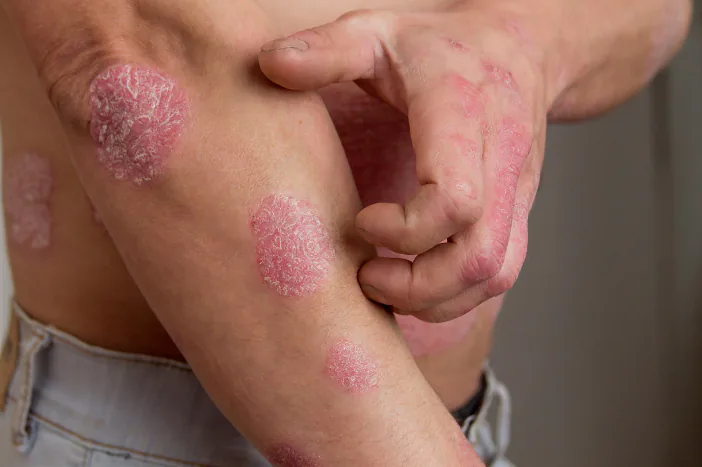
Image example showing several areas on the torso, arm, elbow, and hand. It is not used to grade severity. 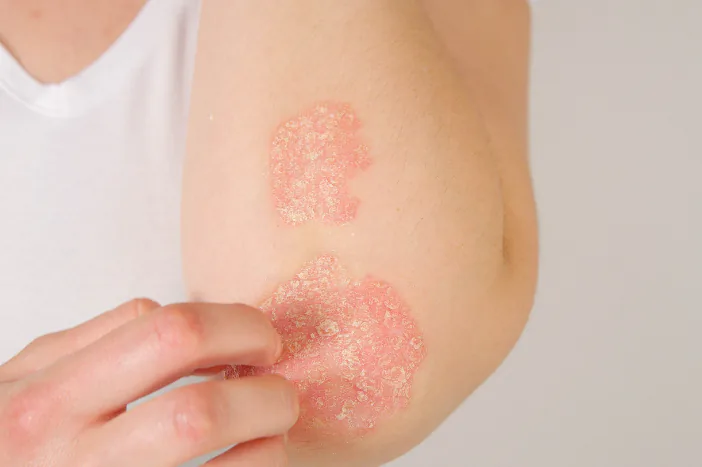
Image example of the elbow and upper arm. Fingers resting on the skin do not confirm itch or indicate severity. 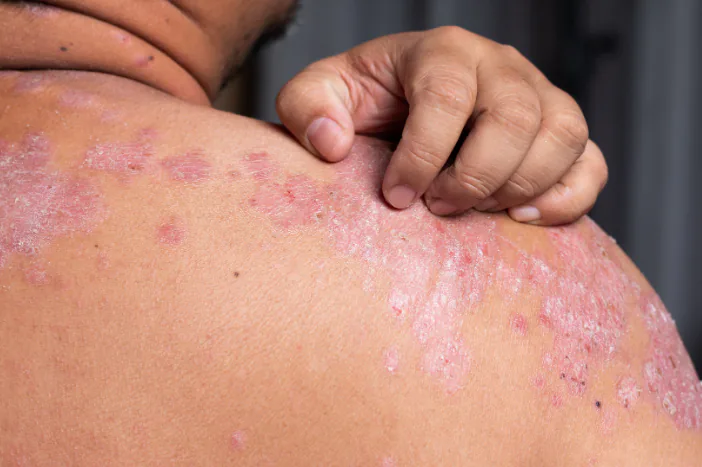
Image example of the shoulder and upper back. A hand resting on the skin does not confirm itch or indicate severity. 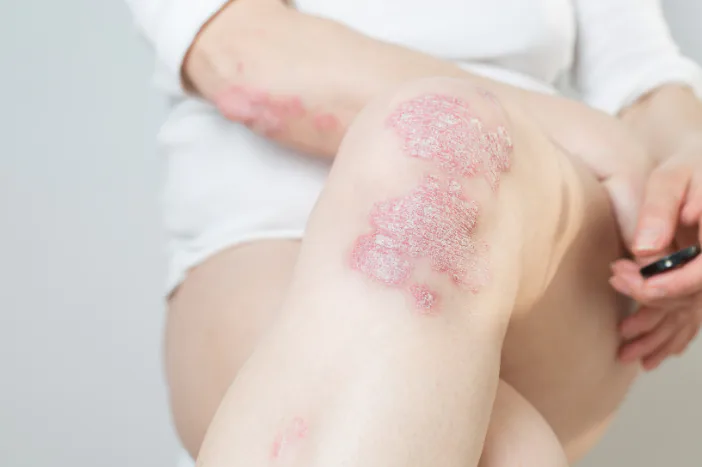
Image example of the knee and upper leg. The object in the hand should not be interpreted as a medicine or treatment device, and the image is not used to grade severity.
Trunk and multiple skin areas
This image shows multiple skin areas within one frame. It is not a severity benchmark.
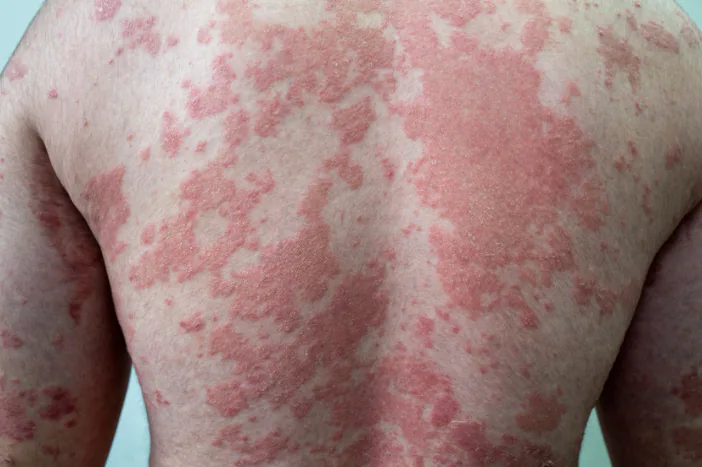
Image example showing several areas on the upper back and upper arms. It is not used to grade severity or show change over time.
Hands and fingers
This image shows only what is visible on the hands and fingers. It cannot confirm a nail or joint abnormality.
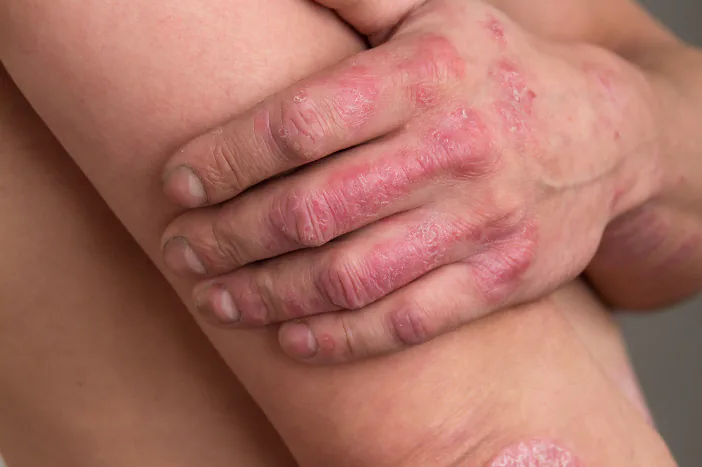
Image example of a hand and fingers. It does not confirm a nail or joint abnormality or a diagnosis.
Illustration of a hand
This illustration is separate from the other image examples and must be read with its AI-generated label.
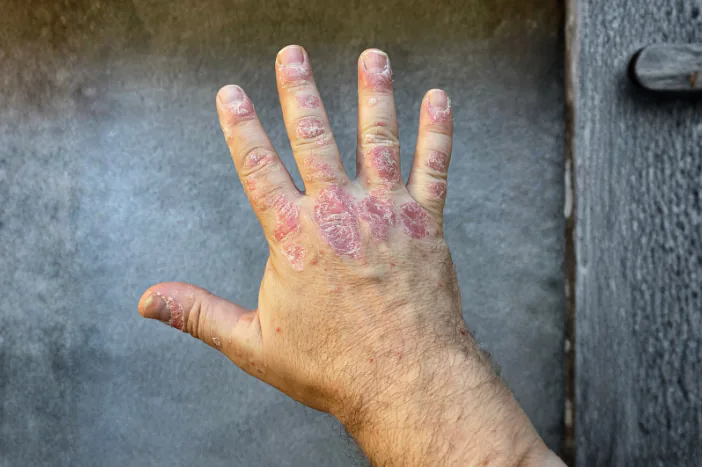
This AI-generated illustration is not a patient image or clinical photograph, and it is not used for diagnosis.
References
These references informed the source copy and are not personal medical advice.
- Psoriasis — Institute of Dermatology, Department of Medical Services. Institute of Dermatology, Thailand Department of Medical Services. 2025.
- Psoriasis: Signs and symptoms. American Academy of Dermatology. current patient guidance.
- Psoriasis: assessment and management (CG153) — Recommendations. National Institute for Health and Care Excellence. 2012; revised 2017; minor updates 2025.
- Psoriasis. National Health Service. updated 2026.
- Dermatology textbook for general practitioners. Institute of Dermatology, Thailand Department of Medical Services. 2024.
- Types of psoriasis and serious warning signs. American Academy of Dermatology. current patient guidance.
- Psoriasis: Diagnosis and treatment. American Academy of Dermatology. current patient guidance.
- Psoriatic arthritis: Symptoms. American Academy of Dermatology. current patient guidance.