

What should you observe before an appointment?
Record both visible changes and symptoms: where the rash is and how it spreads, scale, cracks, bleeding, itch, burning or pain, nail changes, and joint pain, swelling, or stiffness. Note when each began and how it affects daily life.
- Rash locations and the date it began or flared.
- Itch, pain, burning, cracks, or bleeding.
- Nail pits, thickening, colour change, or lifting.
- Joint pain, swelling, stiffness, a swollen digit, or heel pain.
- Current medicines and skin treatments already tried.
What does a clinician assess?
Assessment commonly includes several skin areas, the scalp, nails, and symptomatic joints. The clinician considers the type, location, extent, thickness, inflammation, systemic symptoms, and physical, psychological, and social effects rather than looking only at surface area.
When the diagnosis is uncertain, a clinician may test skin scrapings, take a small skin sample, or order another test according to the possible cause. A biopsy is not required for every person.
How is psoriasis different from fungal infection, dandruff, or seborrhoeic dermatitis?
These conditions can overlap in appearance. Location, border, oiliness or dryness, nail changes, and test results can help, but there is no short rule that safely confirms the diagnosis at home.
Plaques on the body can resemble nummular eczema or fungal infection; scalp disease can resemble seborrhoeic dermatitis or fungal infection; fold disease can resemble yeast or irritant dermatitis; and nail psoriasis can resemble fungal nail disease. Steroid treatment may obscure a fungal rash, so an uncertain rash should be assessed before prolonged treatment.
How is psoriasis severity assessed?
Severity includes the area and features of the rash, difficult or high-impact sites, nail and joint symptoms, systemic symptoms, response to treatment, and effects on sleep, work, relationships, mood, and quality of life.
A small area on the palms, soles, face, genitals, or nails can have greater impact than a larger area elsewhere. Tell the clinician honestly how psoriasis affects your life so the care plan reflects what matters to you.
[4]
Images can explain what is visible, but cannot confirm a diagnosis
Clinicians consider the location, borders and visible features, symptom history, scalp, nails, joints, and tests when needed because several skin conditions can overlap in appearance. Image examples may help you prepare questions, but they are not a diagnosis.
Visible skin features
This close view shows a scaly skin area. A coloured point or small detail alone should not be used to conclude that there is bleeding, infection, or a particular level of severity.
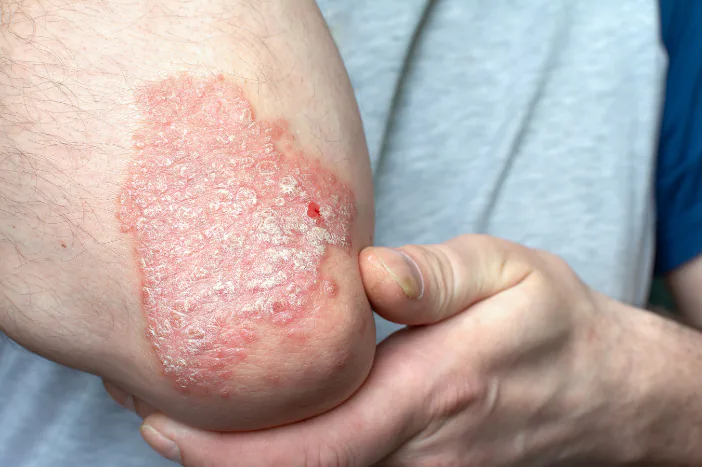
Image example of the elbow. The small red point alone does not confirm bleeding, infection, or severity.
Images that need clinical context
Visible skin features can overlap with other conditions, so history, examination of several body areas, and other tests when needed help distinguish them.
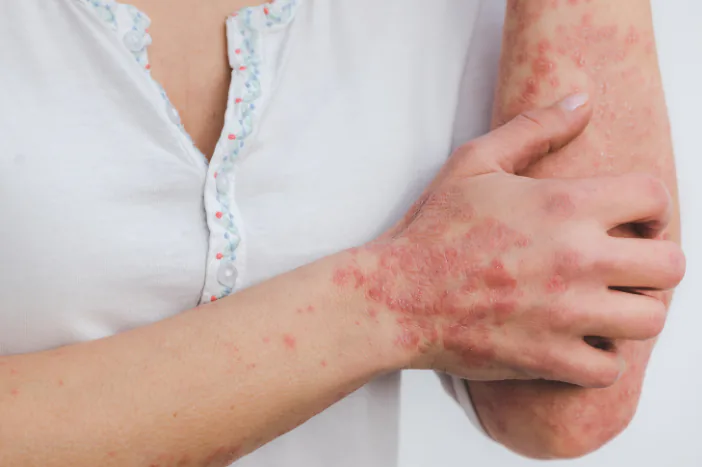
Image example showing varied visible areas on the arms. An image comparison alone cannot distinguish psoriasis from other conditions. 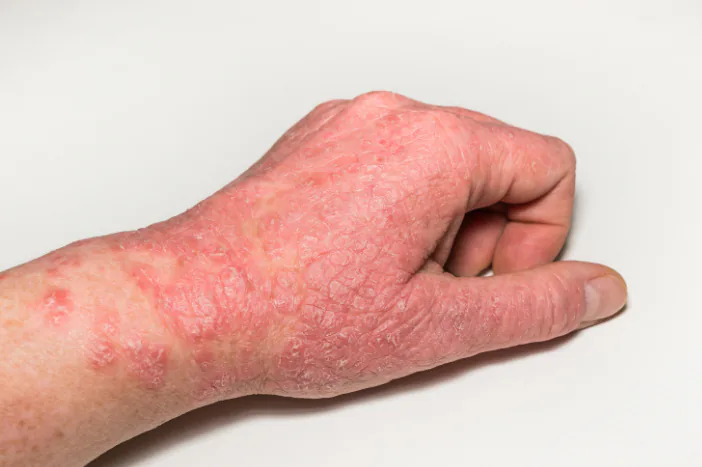
Image example of a hand and wrist. A dry, scaly appearance alone cannot identify the cause or confirm a diagnosis.
Close images with visible skin detail
These images show clear skin detail, but some do not show the body location clearly. Do not infer the location, cause, infection, or severity from an image alone.
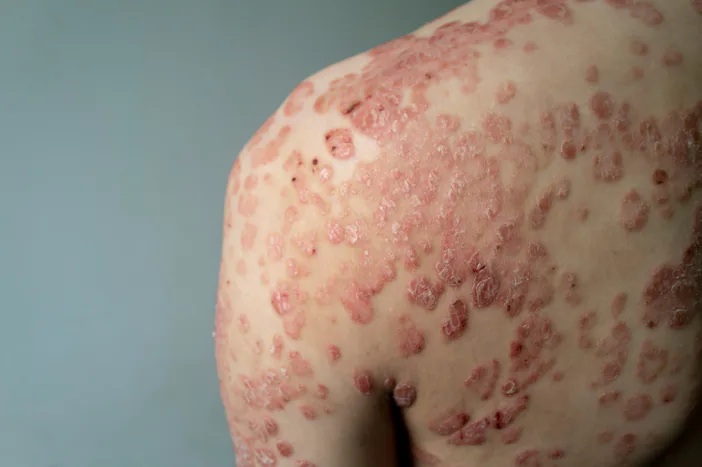
Detailed image of a body area whose location is not clear from the frame. Its location or severity should not be inferred. 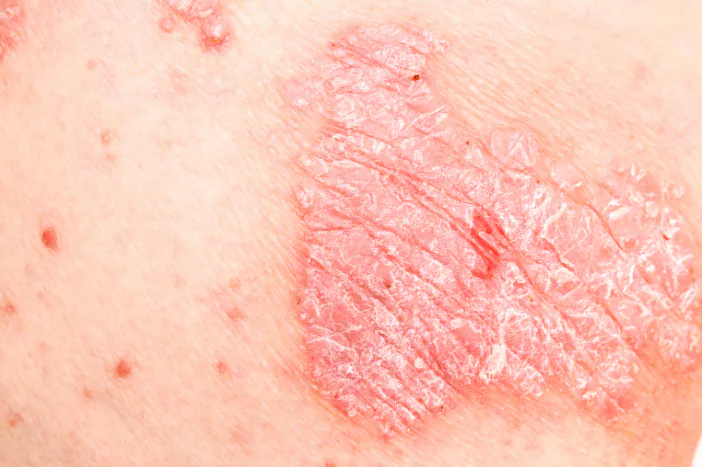
Extreme close view without a visible body location. Small red or crust-like points do not confirm bleeding, infection, or injury. 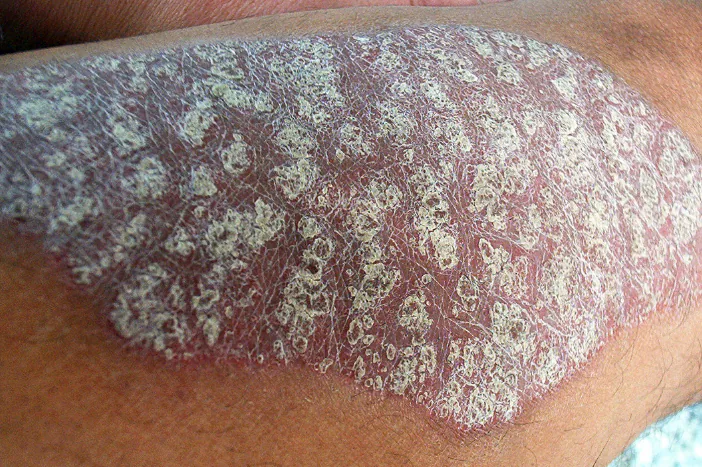
Close image showing clear skin detail. The frame is not enough to confirm the body location, cause, or severity.
References
These references informed the source copy and are not personal medical advice.
- Psoriasis: Diagnosis and treatment. American Academy of Dermatology. current patient guidance.
- Psoriatic arthritis: Symptoms. American Academy of Dermatology. current patient guidance.
- Psoriasis — Institute of Dermatology, Department of Medical Services. Institute of Dermatology, Thailand Department of Medical Services. 2025.
- Psoriasis: assessment and management (CG153) — Recommendations. National Institute for Health and Care Excellence. 2012; revised 2017; minor updates 2025.
- Dermatology textbook for general practitioners. Institute of Dermatology, Thailand Department of Medical Services. 2024.
- Psoriasis: Signs and symptoms. American Academy of Dermatology. current patient guidance.